
Entitlement and Misogyny: Men Don’t Hate Being Told No. They Hate Who Gets to Say It.
Updated: Oct 13
In August, I was walking through a cemetery. Yes, a cemetery. Alone, mindlessly wandering with my headphones on, doing absolutely nothing to anyone, and trying to find a little peace.

A man was sitting in his car at a stop sign. Except he wasn't driving. He had plenty of time to go, but instead, he waited. And waited. And waited until I got closer.
Then he stuck his crypt keeper head out of the window and said:
“You're such a Pretty girl…”
You know the drill. A strange man sees a woman existing in public and apparently decides that her existence is an invitation to interact with her. I was not making eye contact. I was not approaching him. I was not soliciting conversation. I was walking through a cemetery, minding my own damn business, with headphones on.
So I told him to go fuck himself.
I screamed it, actually. I think I may have exercised the folks from forever sleep.
He did not appreciate that. Shocker. You can CLICK HERE to see the video I made on Tiktok.
Instead of driving away like a normal person who had just received a very clear indication that his attention was unwanted, he threatened to call the authorities because I was supposedly trespassing. In a public cemetery. The man who had deliberately waited for me, initiated an unwanted interaction, and became angry when I rejected him suddenly needed to establish that I was the one doing something wrong.
And I remember thinking, Oh. There it is.
This wasn't really about whether I was pretty. It wasn't even particularly about my response. It was about what happened when a woman refused to play the role he expected her to play. He initiated the interaction, apparently anticipated a certain response, and then attempted to regain control when I declined to participate.
I had been minding my own business. He wanted my attention. I refused to give it to him. And suddenly, he wanted to establish some kind of authority over me.
That interaction got me thinking about something I've noticed repeatedly, especially with what is happening at Cornell and the complete disregard for women and humanity: Men don't necessarily hate being told what to do. They hate who gets to tell them what to do.
Male Entitlement and Misogyny: They Hate Female Autonomy.
Let's talk about the enormous contradiction here. Men willingly submit themselves to male authority all the time. Entire institutions are built around it, and plenty of men embrace the hierarchy without a second thought.

Consider the military. A male superior can scream in a man's face, tell him where to stand, when to wake up, what to wear, how to behave, and what he is going to do next. The expectation isn't merely that he will listen; it's that he will obey. That submission can be framed as discipline, brotherhood, honor, leadership, or character-building.
Religion operates similarly. A male pastor or priest can tell men how they should live, what they should believe, and what constitutes moral behavior. A male coach can criticize a grown man's performance and tell him exactly what he needs to change. A male boss can determine his schedule, evaluate his work, and decide whether he keeps his job. And then there's the modern alpha-male industry, where men pay thousands of dollars to participate in programs in which other men instruct them on how to become more masculine, more successful, more disciplined, and more powerful.
Apparently, being told what to do isn't inherently emasculating after all. Some men will pay a fortune for the privilege.
So maybe the problem isn't authority. Maybe the problem is who is exercising it, whose authority is considered legitimate, and who is expected to defer.
When another man tells a man what to do, it can be framed as leadership. When a coach corrects him, it's development. When a boss gives him direction, it's employment. But when a woman says, “No, I don't want to talk to you,” suddenly the conversation becomes a referendum on her character. She's rude. She's a bitch. She's arrogant. She's full of herself. She should have been nicer.
Why?
Because in a patriarchal hierarchy, men are often socialized to expect authority, while women are socialized to accommodate it. Men are encouraged to assert themselves, pursue what they want, and regard their desires as legitimate. Women are encouraged to be agreeable, considerate, attractive, approachable, and careful not to make anyone uncomfortable. We are expected to be warm without being presumptuous, confident without being intimidating, and independent without making anyone feel unnecessary.
That is a hell of a balancing act.
The issue isn't that every man consciously believes he is entitled to control women. The issue is that our culture repeatedly reinforces the idea that men's desires deserve accommodation, while women's boundaries are open to negotiation. A woman who refuses to accommodate those desires can be treated as though she has violated an obligation she never agreed to.
This is precisely why the work of Cornell philosopher Kate Manne is so relevant. In Entitled: How Male Privilege Hurts Women, Manne examines how misogyny operates to police gendered expectations, including the idea that women owe men sex, care, admiration, deference, and emotional labor. Her framework helps explain why a woman withholding something a man expects can provoke hostility that seems wildly disproportionate to the original interaction. Manne's work on male entitlement makes the underlying issue clear: the expectation that women should provide men with things they want is not the same as a legitimate right to receive them.
A woman saying no is not asking for permission to reject you. She is exercising autonomy. And autonomy is different from authority. I don't need to be your boss, your mother, your wife, your pastor, or your coach to decide what happens with me. I don't need to outrank you in some imaginary social hierarchy to determine whether I want to have a conversation, go on a date, have sex, provide emotional support, or entertain your existence.
I am the highest-ranking authority on my own boundaries. And that shouldn't be controversial. It's a simple, cut, dry end of story.
Rejection Isn't the Problem. Losing Control Is.
Think about what actually happened in that cemetery. The man could have driven away. Nothing was stopping him. He had a car, a destination, and absolutely no obligation to continue interacting with me. He could have moved on with his day and forgotten about the encounter thirty seconds later.
Instead, when I rejected him, he escalated.
That is the part I find far more interesting than the original comment. He initiated an interaction and apparently expected me to participate in it. When I didn't respond the way he wanted, the dynamic changed. Suddenly, the woman who had been minding her own business became the problem. Suddenly, he needed to establish some kind of power over the situation.
He couldn't make me engage with him voluntarily, so he tried to create consequences for my refusal. And that is why women often experience unwanted male attention differently than men imagine we do. The issue isn't that women are incapable of handling a compliment. We aren't delicate flowers who need protection from hearing that somebody finds us attractive. The problem is that women have learned to pay attention to what happens after the rejection.
Will he laugh and move on? Will he become insulting? Will he follow us, block our path, threaten us, or use his size, position, social status, or some other perceived advantage to regain control of the interaction? Will I be harmed or worst case: Will I end up dead?
We don't know. And that uncertainty is part of what makes these encounters uncomfortable and, in some cases, dangerous.
Women aren't necessarily wary of men because men find us attractive. We're wary because some men respond to rejection with hostility, and we have no reliable way of knowing which kind of interaction we're walking into until we're already in it. The compliment isn't always the problem. The entitlement underneath it can be.
The entitlement says, I wanted your attention, therefore you should give it to me. It says, I approached you, therefore you owe me a response. It says, I desire you, therefore you should at least make my rejection feel good.
But that's not how human interaction works. You don't own access to another person simply because you want it. My face isn't public property. My body isn't public property. My time and attention aren't public property. And my existence in a public space certainly isn't an invitation. Pretty simple rule of thumb: if you wouldn't say it to everyone (and let's be real, men wouldn't say and they wouldn't do, it to other men), then don't say it to women. Why??!! BECAUSE WOMEN ARE PEOPLE.
HOLY SHIT. And now my blood pressure it up. Ugh.
From Personal Entitlement to Institutional Protection: The Cornell Case
The same entitlement becomes even more disturbing when the consequences extend beyond a rude comment or an ugly exchange. Consider the Cornell case that has recently drawn national attention. A woman identified as Jane Doe has filed a civil lawsuit alleging that she was drugged and sexually assaulted by members of the Chi Phi fraternity in October 2024. The allegations have prompted renewed scrutiny of how the university and law enforcement handled the case, as well as protests demanding accountability and the institutionalized and systemic misogyny that riddles every thing in our life. AND, it stirs up the constant fears and lived realities of women, over and over again.
I AM JANE DOE.
We need to be honest about the broader cultural problem the case forces us to confront: women's consent, safety, and credibility are not always treated with the seriousness they deserve, particularly when the people accused of harming them belong to powerful or socially protected groups.

The entitlement at issue is disgusting because it treats another person's body and autonomy as secondary to what someone else wants. It turns access into an expectation and a woman's refusal into an obstacle to overcome. And when alleged harm becomes public, the conversation can shift astonishingly quickly from what happened to the woman to what might happen to the men accused of harming her. Their futures, their reputations, their educations, their discomfort. Her credibility, her decisions, her character, her behavior.
Who gets the benefit of the doubt? Whose life becomes the tragedy? Who is expected to be quiet, reasonable, forgiving, and careful not to ruin anyone else's life by telling the truth about her own?
That is where entitlement and hierarchy meet. It is not simply about whether an individual man can tolerate hearing no. It is about a culture in which some people are accustomed to having their wants prioritized, their authority protected, and their behavior excused, while other people are expected to absorb the consequences.
And we see the same underlying expectation in far more ordinary interactions. Women are taught to soften rejection, smile while delivering it, explain it, and make sure the man receiving it doesn't feel humiliated. We're told to say we're married, claim we have a boyfriend, or invent some external reason for not being interested, as though our own lack of desire is somehow insufficient.
There is an entire social script designed to make a woman's no more palatable to a man. Beneath it is an assumption that deserves far more scrutiny: that a man's emotional reaction to a woman's boundary is somehow the woman's responsibility.
It isn't. If I reject you, you are allowed to feel disappointed. You're allowed to feel embarrassed, think I'm rude, or decide you don't like me either. What you are not entitled to do is punish me because I didn't give you the response you wanted. Adults have feelings. Adults also manage their feelings. Women should not have to perform emotional labor for strange men simply because those men decided they wanted access to us.
Could I have said, “No, thank you”? Sure. Could I have smiled and kept walking? Absolutely. Instead, I told him to go fuck himself. Was it polite? No. Was I obligated to be polite to a stranger who had deliberately waited for me, initiated unwanted contact, and then became hostile when I rejected him? Also no.
Women are allowed to be rude. This seems to be a genuinely difficult concept for some people. Sometimes “rude” is simply what a boundary looks like when you aren't interested in making the other person comfortable. And perhaps that's one of the reasons female autonomy can feel so threatening to people who are accustomed to women being accommodating. A woman who is willing to disappoint you without apologizing is a woman you cannot easily manipulate through guilt.
She isn't asking, Are you okay with my no? She's saying, My no doesn't require your approval.
The expectation that women must manage men's reactions also explains why so many people are eager to defend men from the consequences of their own behavior. In feminist philosophy, Kate Manne uses the term “himpathy” to describe the disproportionate sympathy extended to male perpetrators or accused men at the expense of women who say they have been harmed. It is not a substitute for due process, and fairness matters. But fairness cannot mean that the discomfort of a man accused of wrongdoing automatically outweighs the safety, dignity, or testimony of the woman bringing the complaint.
We can insist on evidence and accountability at the same time. We can refuse to prejudge a legal case without dismissing the cultural patterns that make women afraid to speak. And we can stop pretending that protecting a man's reputation and protecting a woman's autonomy are always competing moral obligations. They are not.
Single and Childfree Women Know What It Means to Be Out Here Alone

This is where the conversation gets personal for me, because single and childfree women already understand what it means to move through a world that assumes somebody else will be there to protect, support, or advocate for us.
We have been out here. We are out here. We handle our own emergencies, make our own decisions, build our own financial security, and navigate situations in which there is no automatic partner to call, no spouse to step in, and no guarantee that someone will notice if we need help. That doesn't mean every single woman is isolated or that partnered women never experience vulnerability. It means that our social structures often assume a default support system that not everyone has.
And when you are accustomed to managing your life independently, you become acutely aware of the difference between being capable and being invulnerable. I can travel alone, walk into a gym in a language I barely speak, make decisions for myself, and build a life I genuinely love. I can also recognize that being independent does not eliminate the risks of moving through a world in which some people feel entitled to women's attention, bodies, labor, and compliance.
I should not have to calculate the potential consequences of rejecting a stranger while walking through a cemetery. I should not have to consider whether a man will accept my answer, whether he might follow me, or whether he will decide that my refusal warrants punishment. And I should not have to make myself smaller to avoid provoking a person who has decided that my autonomy is an insult.
Yet women are routinely expected to make those calculations. We are told to be vigilant, plan ahead, share our locations, carry our keys between our fingers, watch our drinks, avoid walking alone, and think carefully about how we reject men. Personal safety advice can be useful, but let's be clear about what it often asks of women: we must anticipate the possibility of someone else's misconduct and organize our lives around preventing it.
We are expected to do all of that while remaining pleasant enough not to offend anybody. And then people wonder why women want community. It's so exhausting.
Community Is Infrastructure
For single and childfree women, community is not some cute lifestyle accessory or a consolation prize for not having a husband and children. It is infrastructure. It is knowing who you can call when something goes wrong, who will check in when you disappear from the group chat, who will help you think through a difficult situation, who will believe you when you say something felt wrong, and who will show up when showing up matters.
It is the friend who knows where you are traveling. The woman who walks with you to your car. The person who makes sure you got home. The group that takes your concerns seriously instead of telling you that you are overreacting. The women who understand that independence does not mean you have somehow opted out of being human.
And this is why I have very little patience for the pick-me water carriers who show up in women's spaces to defend the very systems that make those spaces necessary. You know the type: women who rush to explain men's behavior, police other women's boundaries, insist that we should be nicer, and treat any criticism of patriarchal expectations as a personal attack on men. They are so committed to being the exception, the agreeable one, the woman who gets along with everybody, that they will throw other women under the bus to prove it.
They want the benefits of women's spaces without the solidarity that makes those spaces meaningful. They want to cosplay community while carrying water for the hierarchy that undermines it.
No, thank you.
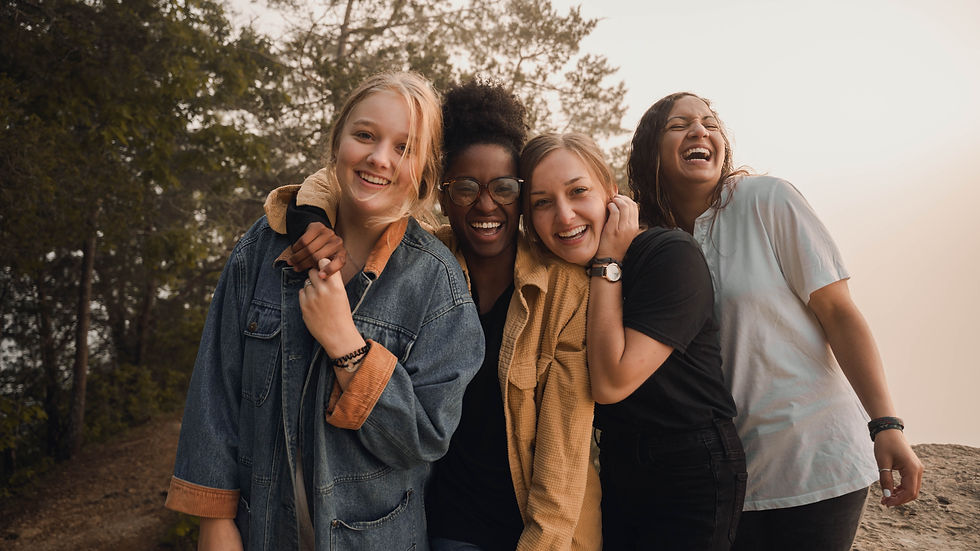
The point of a community for single and childfree women is not to create another space where we must prove that we're sufficiently accommodating, sufficiently feminine, sufficiently agreeable, or sufficiently sympathetic to men's feelings to deserve belonging. It is to create a place where we can be fully human without having to justify our lives or apologize for our boundaries. A place where we can support one another without competing for male approval, where we can talk honestly about the realities of being women in the world, and where we can build the relationships that make independent lives richer, safer, and less lonely.
Because here's the thing: what will keep us safer is each other, not our willingness to appease men (all the pick me water carriers can just...sit down and read a book).
It is women believing one another, looking out for one another, sharing information, showing up, and refusing to let someone stand alone when a situation becomes uncomfortable or dangerous. It is building networks of trust rather than assuming a husband will always be there to help. It is recognizing that a woman who says no is not creating a problem by refusing access; the person who refuses to respect that no is creating the problem.
And it is understanding that a community is not just a collection of people who happen to share a demographic. It is a commitment to how we treat one another, especially when doing the right thing is inconvenient.
No Is Not Up for Negotiation
I don't know what the man in the cemetery thought he was entitled to that afternoon. Perhaps he expected a smile. Perhaps he expected me to stop and entertain him. Perhaps he expected me to be flattered. What I do know is that he was not entitled to any of those things, and my refusal did not give him permission to threaten me.
Men don't hate being told what to do. They take orders from drill sergeants, listen to coaches, work for bosses, follow religious leaders, and pay other men to tell them how to become better men. What some men seem to hate is a woman deciding for herself what she will and will not participate in, without asking them for permission or approval.
And single and childfree women have every reason to recognize why that matters. We are building lives outside the traditional structures that patriarchy has long treated as women's proper destination. We are making decisions for ourselves, creating our own support systems, and refusing to accept the idea that a woman must be partnered, maternal, or endlessly accommodating to be worthy of respect.
My independence is not an invitation to test my boundaries. My singleness is not an open application for a man to fill a position. My childfree life is not evidence that I have nothing better to do than manage somebody else's feelings.
I can handle a man being disappointed. I can handle a man thinking I'm rude, difficult, or a bitch. What I will not do is make myself smaller so a stranger can feel bigger, and I will not confuse keeping the peace with keeping women safe.
Their discomfort is not our emergency. Their entitlement is not our obligation. And their desire for access to us is not a right.
No is a complete sentence. Even in a cemetery. Even at a frat party. Even when the consent changes. Even to a stranger.
Even when he doesn't like it. Especially then.



100%! Yes to all of this.
🙌🏻🙌🏻🙌🏻🙌🏻🙌🏻🙌🏻🙌🏻🙌🏻🙌🏻🙌🏻🙌🏻